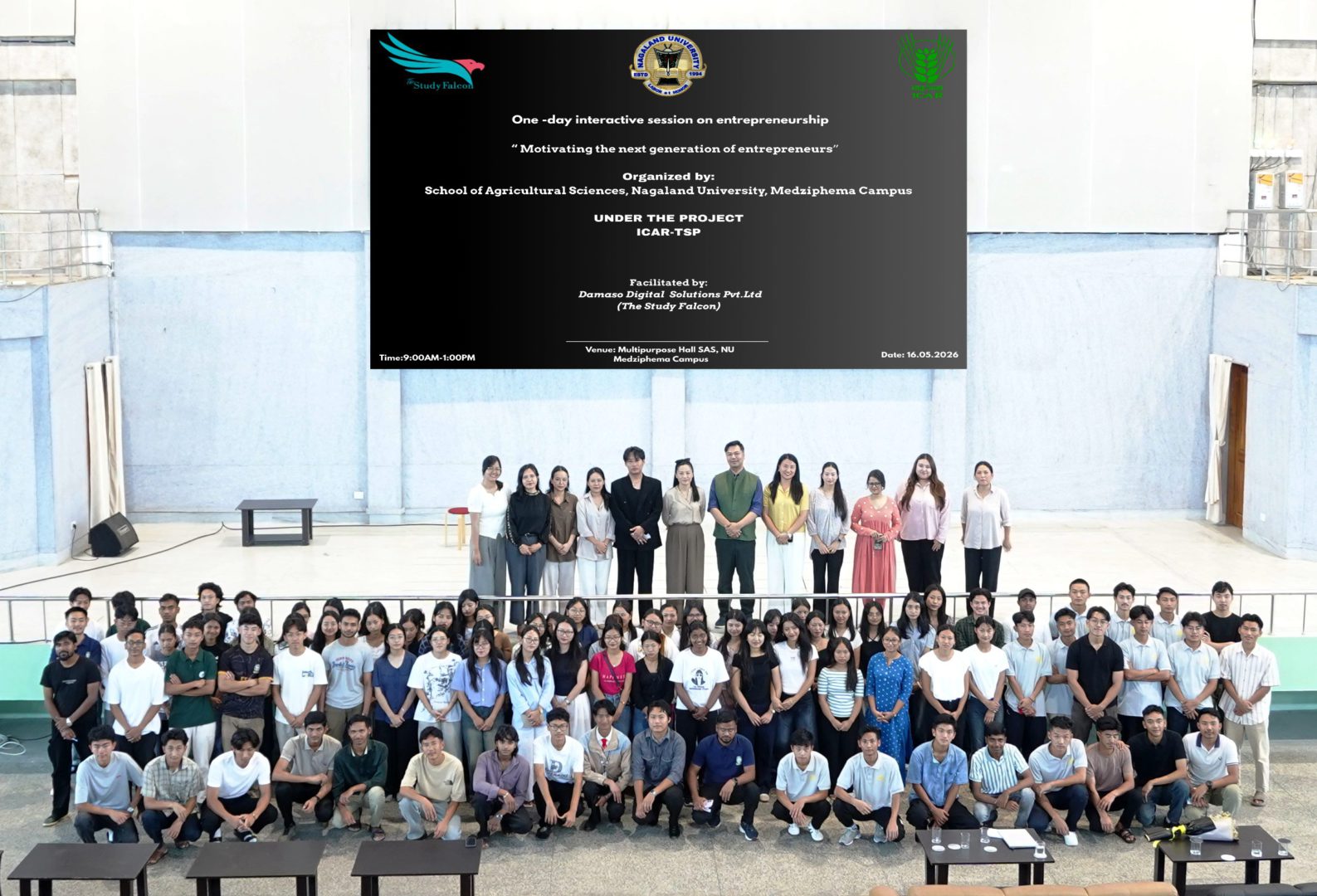

Founder Kevisato Sanyü joins students at SAS, NU for a frank conversation about careers, initiative, and what it means to build something in Nagaland.
AT A GLANCE
On 16 May 2026, the School of Agricultural Sciences at Nagaland University (SAS, NU) hosted a one-day interactive session on entrepreneurship, organised by the Indian Council of Agricultural Research’s Tribal Sub-Plan (ICAR-TSP) and facilitated by Damaso Digital Pvt. Ltd. (The Study Falcon). Students gathered for a morning designed not to give them answers, but to change the questions they were asking about their own futures.
The session was held under the project “Development of Soft Skills, Professional, Business, and Entrepreneurship Skills for Employability amongst Students” — a programme that recognises what many students in Nagaland already know: the gap between qualified graduates and available jobs is wide, and growing. What the programme sets out to do is help students see what lies on the other side of that gap.
Kevisato Sanyü, Founder of NagaEd, was the session’s resource person. He did not arrive with a presentation about entrepreneurship in the abstract. He arrived with his own story.
The Person in the Room Mattered as Much as the Message
Kevisato arrived with his own story — of building a digital education company from Nagaland, for Nagaland, in a region where that kind of venture is still rare enough to raise eyebrows.
That specificity was deliberate. It is one thing to tell students that entrepreneurship is possible. It is another to sit across from someone who navigated the same uncertainties, and built something that now reaches tribal and indigenous communities across Northeast India. The messenger and the message were, in this case, the same thing.
[QUOTE NEEDED — Kevisato Sanyü.]
Understanding Yourself Is Where It Starts
The second session shifted from conversation to activity. Aonok Aier, Head of Projects and Learning Excellence, with the NagaEd team, led participants through an exercise built around the DISC framework — a personality and leadership profiling tool that helps individuals understand their natural tendencies across four dimensions: Dominance, Influence, Steadiness, and Conscientiousness.
The exercise was not incidental to the day’s theme. Understanding how you naturally think, communicate, and lead is foundational to any serious conversation about entrepreneurship. Students who can name their strengths are better placed to identify the kinds of ventures that suit them, the kinds of collaborators they need, and the kinds of challenges they are likely to underestimate. Self-knowledge, in this context, is a practical tool.
A Different Kind of Career Conversation
Nagaland’s employment landscape is one in which government jobs remain the dominant aspiration — not without reason. In many districts, they represent the most reliable route to stable income. But the number of positions available has never matched the number of graduates competing for them, and that imbalance is not narrowing.
What sessions like this one offer is not a replacement for that aspiration, but a widening of it. The goal is not to convince students that entrepreneurship is easy. It is to show them, through someone who has done it in Nagaland, that it is possible — and that the skills required are not as distant from their own lives as they might assume.
The Session Ended. The Question Didn’t.
Entrepreneurship in Nagaland does not lack for people with good ideas. What it has historically lacked is spaces where those ideas are taken seriously early — where students are asked what they want to build before the weight of practical expectation narrows the answer down to a single option.
What today’s session offered was not a roadmap. It was something more foundational: the experience of being in a room where the question was asked, where someone who looked like them had answered it by building something, and where the tools to begin thinking about their own answer were placed in their hands.
That is not a small thing.